
Your Cart

Your cart is empty

Indian Paintings Online: Shop Original Handmade Folk Art

Shop Indian paintings online at Rooftop. Authentic handmade folk art - Pichwai, Madhubani, Gond, Warli and more - created by India's master artists. Buy original Indian art.

Showing 1 – 4 of 4

Artventures of Baiga: The Complete Guide to Madhya Pradesh's Tribal Art (Set of 3)
15% OFF

Activity Books

Artventures of Baiga: The Complete Guide to Madhya Pradesh's Tribal Art (Set of 3)

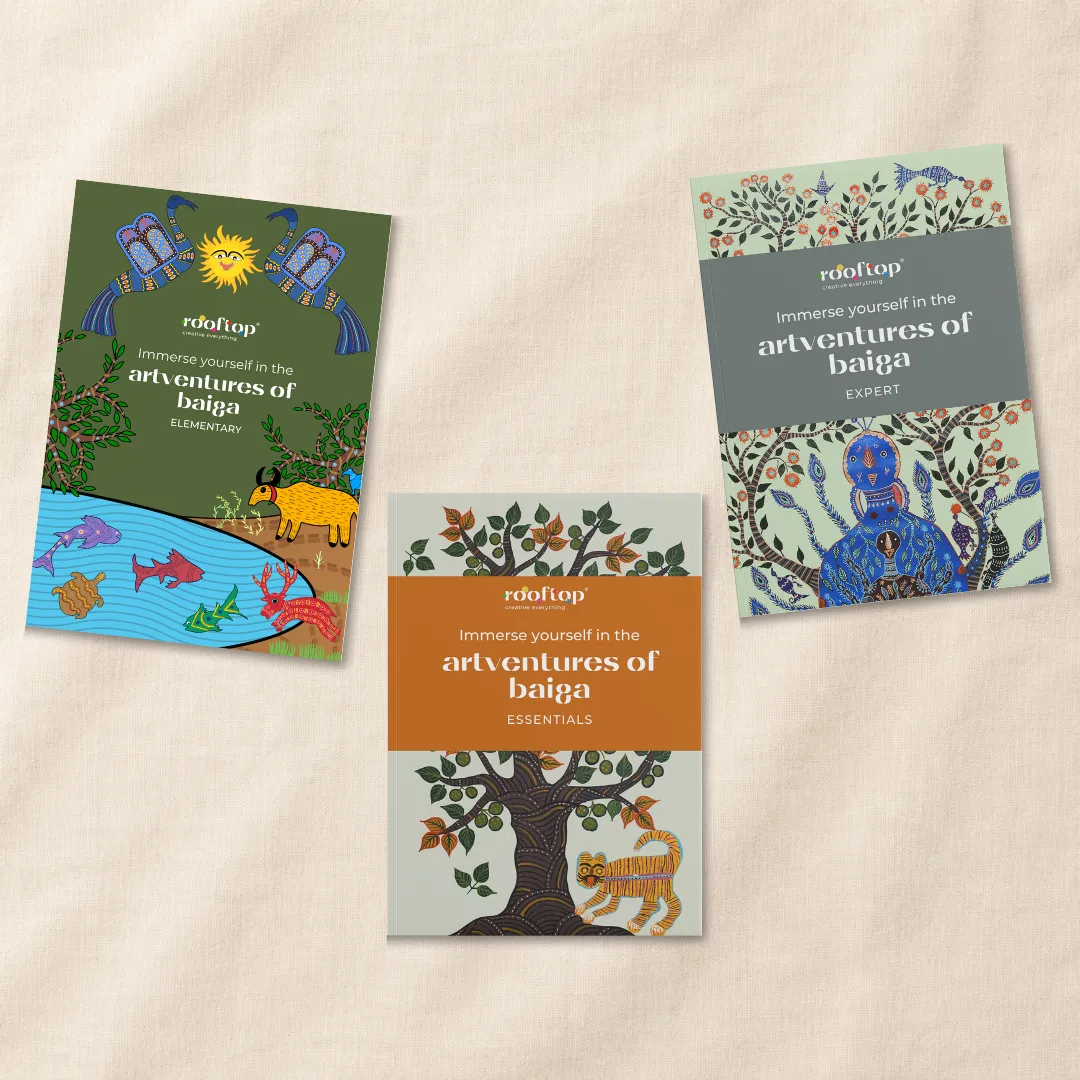
Baiga painting belongs to a Particularly Vulnerable Tribal Group living across six districts of Madhya Pradesh. For most of its history it existed on two surfaces only, the mud walls of Baiga homes and the skin of Baiga women, marked through a tattoo tradition called Godna that records a woman's life in a fixed order, from the Seeta Rasoi design at adolescence to the dot patterns applied after marriage. Neither surface was built to last. It took an outside artist, the late Ashish Swami, arriving in Lorha village and training more than thirty local women to work on paper, for any of it to survive past a monsoon. Jodhaiya Bai Baiga was among them. She was 69 when she painted on paper for the first time in 2008, and she received the Nari Shakti Puraskar in 2022 and the Padma Shri in 2023, fifteen years after she started. The Artventures of Baiga set of three books takes you through that tradition from a child's first pattern to a full staged composition. Elementary tells the story through Prakash, a boy who finds his Amma painting animals on their wall and learns the history through her answers, then works through seven pattern pages and six four-step motifs. Essentials drops the story frame and gives adult learners the material straight: the five-colour palette and where each pigment comes from, the three Baiga deities, and a full section on Godna, before moving into six reference paintings and thirteen creative exercises. Expert is the only book with a dictionary, roughly forty catalogued forms across patterns, motifs, deities, trees and weapons, alongside staged compositions like a Ramayana episode of your own choosing and a Kali sketch to complete with tattoo work. Every motif across all three books traces back to five women of Lorha village, Umaria district: the late Jodhaiya Bai Baiga, along with Sakun Bai Baiga, Ramrati Bai Baiga, Rupa Baiga and Hema Baiga, three generations of one family. Three of them, Sakun Bai, Ramrati and Rupa, are painting and teaching today. What makes this set stand out - The three levels cover the full arc of the form, from Prakash and Amma's first pattern in Elementary to the dictionary and staged Ramayana compositions in Expert. - Reference paintings across the set are credited by title and artist to five working women of Lorha village, not adapted anonymously. - Essentials and Expert cover material most tribal art books skip entirely, including the Godna tattoo tradition, the three Baiga deities, and what urbanisation is doing to both. - The set works as a child's first activity book, an adult's practice workbook and a reference library for someone already painting, without repeating itself across levels. -
$ 69$ 79
Artventures of Baiga - Expert

Activity Books

Artventures of Baiga - Expert

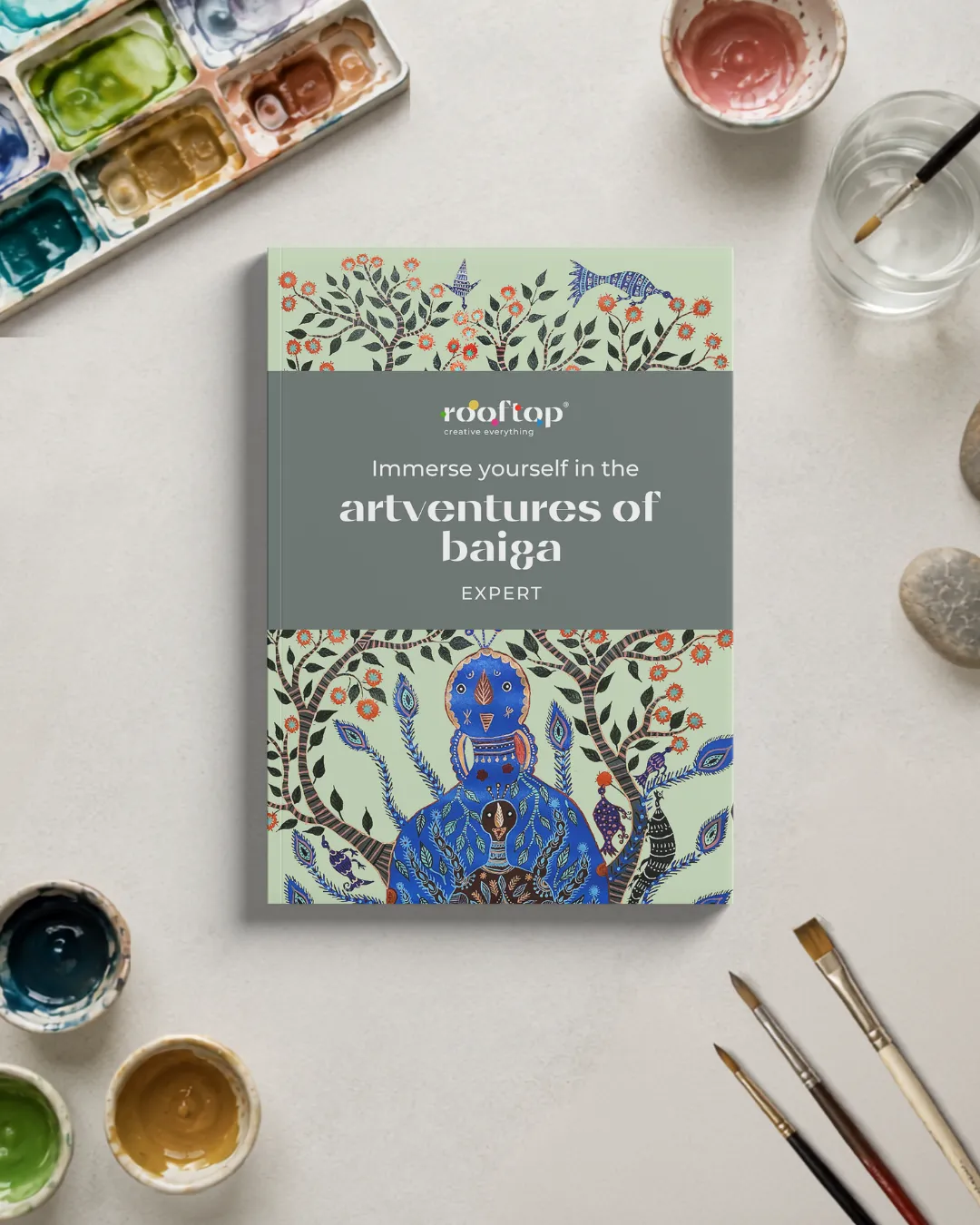
Artventures of Baiga: Expert is the last book in the series and the only one with a dictionary in it. Two pages of patterns and two pages of motifs, catalogued: Chora Devi, Ganesh Ji, Mahua Devi and Bada Dev; four human figure types; temple, sun, incense sticks and flag; the Saja, Mahua, Kullu and Palash trees with four leaf forms; elephant, deer, peacock, monkey, parrot, bear, sparrow, porcupine, tiger, cow, tortoise, snake, fish, scorpion and crab; and the weapons, shield, spear, mace, bow and sickle. Everything needed to build a composition without inventing shapes. The history section covers ground the other two books leave out. Baiga painting lived on walls until the late Shri Ashish Swami, a fine artist trained at Kala Bhavan in Shantiniketan, came across it in Lorha village in Umaria district. He trained more than thirty women there. Jodhaiya Bai Baiga was among the first to paint on paper, starting in 2008 at the age of sixty-nine, and she received the Nari Shakti Puraskar in 2022 and the Padma Shri in 2023. Baiga legend credits the art form to the goddess Mavai, who came down to teach the community to make designs from clay, leaves and plant dyes. Separate sections cover Mahua Devi and the Mahua tree, whose flowers are gathered in season and made into a drink shared at every important festival; Bada Dev and the rituals performed before planting and harvest; and the Ojhas and Badnins who tattoo Baiga women, working with soot mixed with water and passing the designs down orally from mother to daughter. Six animals get individual entries explaining what each means in Baiga work: deer, bear, tiger, elephant, peacock and snakes. A contemporary outlook section takes on the harder question of what happens to the form under urbanisation. Fewer young Baiga take the tattoos. Artists have moved to canvas and acrylics. The book treats both as adaptation rather than loss and says why. The practice sections are the hardest in the series. Eight full-page reference paintings for study. Four advanced pattern exercises. Nine advanced motif pages covering trees, three levels of deity motifs, humans, reptiles, land animals and two pages of aquatic ones. Then compositions: recreate Whispering Woods and Joyous Jungles from reference, trace and colour a deer-and-snake scene around a Mahua tree, complete a Kali sketch with tattoo designs, finish the missing half of a paired peacock, and choose an episode from the Ramayana and stage it in Baiga style. Creative exploration goes fully open. Build a Baiga cosmos with sun, moon and constellations. Invent forest guardians from animal, tree and spirit elements. Reimagine your own favourite festival. Illustrate a Baiga folktale. Draw a Baiga treehouse. The book closes with a trivia section: spot the difference, a word search, and a twenty-clue riddle hunt, with answer keys.

$ 39
Artventures of Baiga - Essential

Activity Books

Artventures of Baiga - Essential

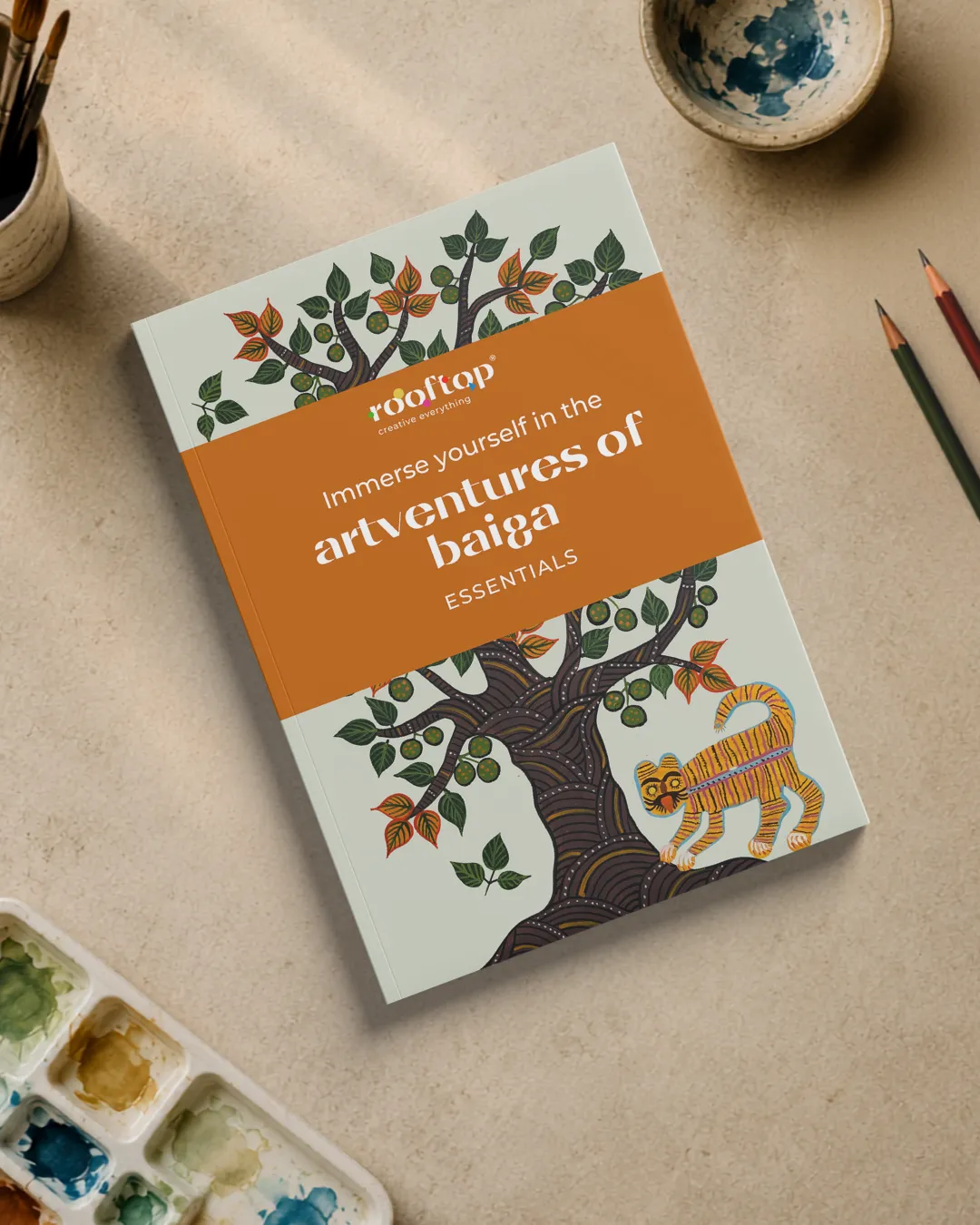
Artventures of Baiga: Essentials is the second level of the Baiga series, written for people who want to understand the art form before drawing it. The opening section covers where Baiga painting comes from and how it works. The word Baiga means sorcerer or medicine man. The community is classified as a Particularly Vulnerable Tribal Group and lives across Mandla, Dindori, Shahdol, Umaria, Balaghat and Amarkantak in Madhya Pradesh. The palette runs to five colours: red, blue, brown, yellow and black, traditionally made from turmeric, indigo, vermilion, white clay and rice paste, and applied with brushes cut from bamboo sticks. Three deities get their own pages. Bada Dev, guardian of the forest, worshipped before planting and again before harvest. Baghsur, the tiger spirit, prayed to for safety by people who work inside forests where tigers live. Kali Mata, who the Baiga treat as a protective mother rather than only a destroyer. A full section covers Godna, the Baiga tattoo tradition. Seeta Rasoi on the forehead marks adolescence. Kajeri and Palani, made of dots, are applied after marriage. The ink is made from black sesame, Bija wood or the fluid of the Malwan tree, the work is done by women called Godharins using thorns and needles, and turmeric and herbal oil go on afterwards to heal the skin. Men are kept away from the process, which the Baiga believe would otherwise affect their hunting. Then the practice begins. Six reference paintings are reproduced full-page for study, including Mahua Devi and the Tree by Jodhaiya Bai Baiga and Bholenath Ka Darbaar by Sakun Bai Baiga. Six pattern exercises follow, each with a fact about Baiga life on the same page. Motif sections cover animals, reptiles, trees and human figures across seven pages. The creative exploration section is the longest. Repaint two lizards in your own colours. Recreate a full tree-and-animal scene on the opposite page. Add pattern to a bull's horns, a Baiga lamp and a Sheshnaag. Build a family around a lone peacock. Draw the villagers around a Mahua tree. Bring a barren Palash tree into spring. Put devotees around Bada Dev. Fill an entire background behind a peacock, because Baiga painters leave no negative space.

$ 29
Artventures of Baiga– Elementary

Art & Design Books

Artventures of Baiga– Elementary

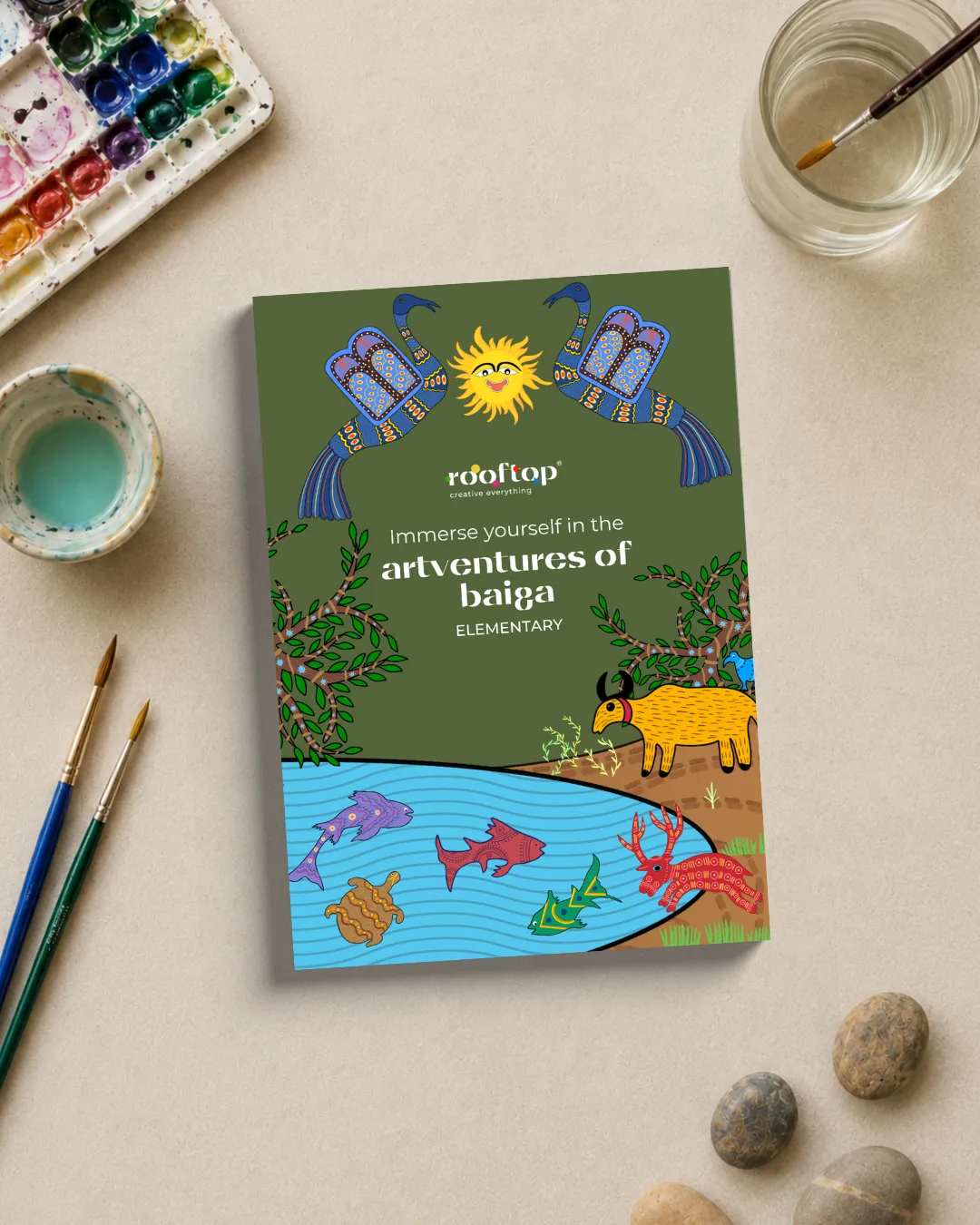
Artventures of Baiga: Elementary teaches children the tribal painting of the Baiga community of Madhya Pradesh through a story. Prakash walks home from school and finds his Amma painting animals onto the wall of their hut. Over the next few pages she tells him who the Baigas are, why they call themselves children of the soil, and what the marks on her own hands mean. The art lesson arrives inside the conversation rather than in a box on the side of the page. Pattern practice starts the drawing sections. Seven pages of them: dots, wavy lines with sparks, zigzags that Amma compares to lightning, flower-and-dot borders. Motifs follow, each one broken into four numbered steps with the facing page left blank to practise on. A tiger, a Nandi, a caterpillar, two peacocks and a crab. The last third is activity pages. Join the dots to finish an owl and a turtle, fill Ganesha and Mushak Raj with Baiga dots and spirals, complete a bare tree by drawing the animals that should be living in it, and add to a herd of deer using a different pattern on every one. Two notes pages sit at the end for whatever comes next. The motifs and reference paintings come from five women of Lorha village in Umaria district: the late Jodhaiya Bai Baiga, who was awarded the Padma Shri in 2023 and started painting at the age of sixty-nine, along with Sakun Bai Baiga, Ramrati Bai Baiga, Rupa Baiga and Hema Baiga. Three generations of one family, all of them still working.

$ 19