


Morpankh is Hindi for peacock feather. Morpankh art means two things in India:
- the feather painted as a motif, in Pichwai, Madhubani, mehndi and temple murals
- the real feather used as material, in fans, crowns and ritual whisks
Both come back to one image, the feather tucked into Krishna's hair. This guide covers where the feather comes from in the stories, how painters and craftspeople use it, and how to draw one.
What counts as morpankh art
Painters reduce the feather to three parts: the eye, the rings of colour around it, and the fine barbs that fan out from the shaft. The eye is a dark blue-black teardrop inside a band of turquoise and then copper. Every tradition keeps those rings and changes the barbs:
- Pichwai painters lay them in with a single-hair brush.
- Warli artists turn the whole bird into a few white strokes.
- Baiga painters fill the tail with their own dotted patterns.
Shree Krishna And Morpankh
There are many beliefs about the connection between Shree Krishna and Morpankh, but the most well-known one is that when Shree Krishna and his friends in Vrindavan rested under a tree after playing, Shree Krishna often played the flute for his friends and his own enjoyment. When he played the flute, the sweet and peaceful sound spread joy. One day, as Shree Krishna played the flute joyfully, many birds and animals gathered around him, including peacocks.
They all enjoyed and danced to the flute sound. When Krishna stopped playing the flute, the birds and animals wanted more music. The peacock king came forward and said that Krishna's music made the environment festive, so he offered a morpankh as a gift. Krishna accepted the morpankh with all his heart and placed it on his head. In Nathdwara, Shrinathji, the child Krishna, wears a peacock-feather crown, and Pichwai painters repeat the feather across the hangings made for his shrine.
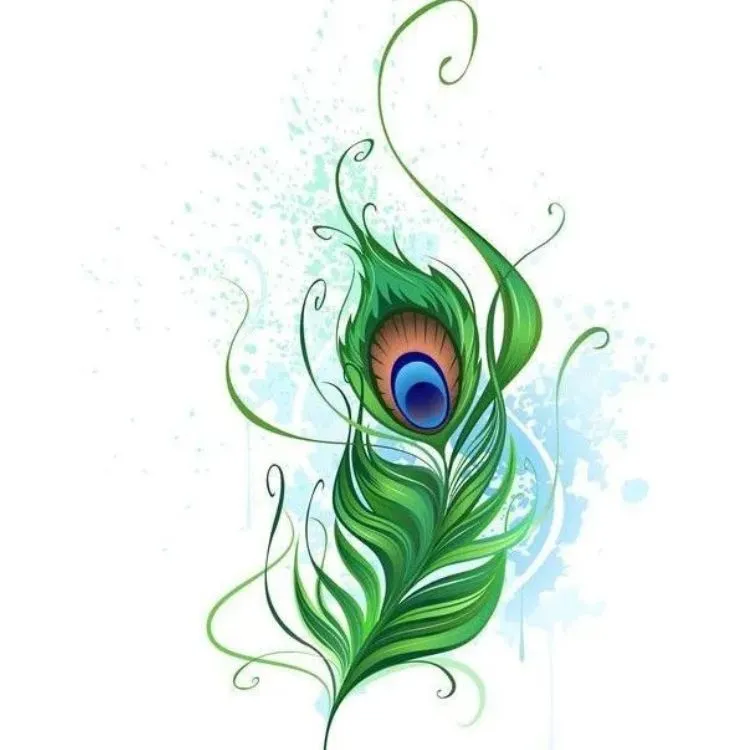
Colorful Peacock Feather Painting (image source: Pinterest)
Kartikeya's peacock
The peacock is the vehicle of Kartikeya, Shiva's son, known in the Tamil country as Murugan. In the Tamil retelling, the demon Surapadman, facing defeat, turns himself into a mango tree. Murugan splits it with his spear, and the two halves become the peacock he rides and the rooster on his banner. In his worship, mainly in South India, peacock feathers are used for decoration. In photos, Kartikeya is often shown sitting on the peacock. In his worship, mainly in South India, the morpankh is used for decorations.
Peacock and Indian Gods
The Uttara Kanda of the Ramayana tells of the gods taking animal forms to escape Ravana. Indra becomes a peacock and, in thanks, gives the bird the thousand eyes on its tail. Peacock is also connected with Devi Saraswati for beauty, grace, and art. Devi Saraswati is the embodiment of knowledge, beauty, music, and art. When artists paint Devi Saraswati, the peacock and morpankh are sometimes included in the image. Sometimes, Devi Saraswati is shown sitting on a peacock.
The peacock feather in craft and worship
The real feather has jobs as well as meanings:
- Morchhal. A bundle of feathers bound into a whisk is waved before deities in temples and Pushtimarg havelis.
- Pichhi. Digambara Jain monks carry a peacock-feather whisk to brush insects gently from where they sit.
Peacocks drop their long train feathers every year after the breeding season. Those shed feathers are what craftspeople use, since the peacock is a protected species.
The Peacock in Indian Art: Warli Peacock Dance
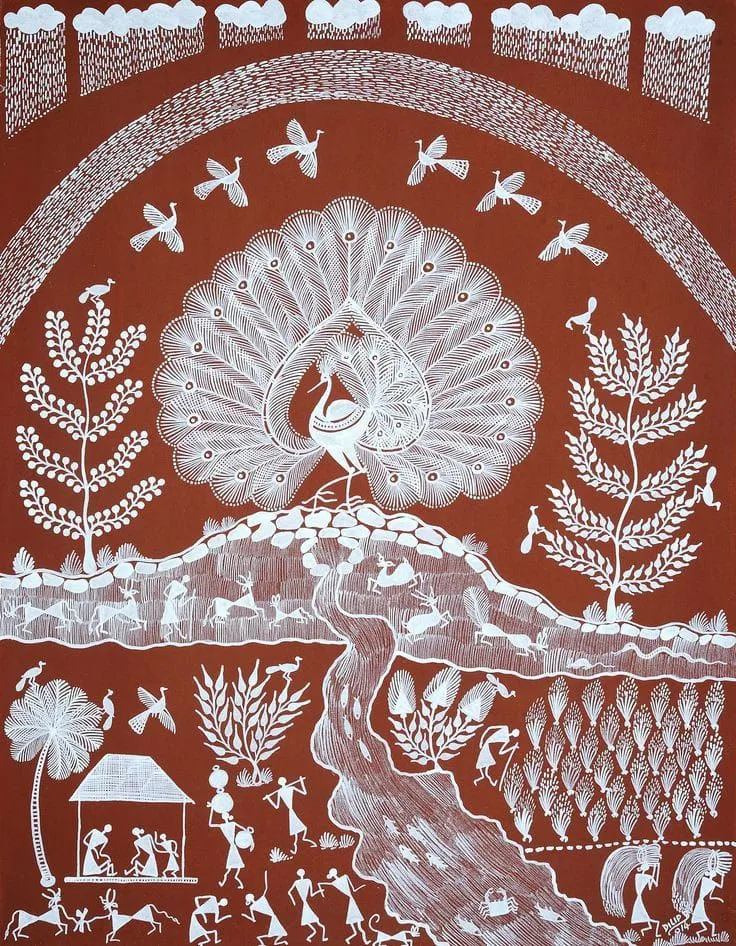
Dance In Warli Village, Warli Painting (image source: Pinterest)
The Peacock is a common sighting in Warli paintings depicting the monsoon. This Warli painting portrays a lively harvest festival in a Warli village. The central focus is on the peacocks, depicted with elegance, beauty, and prosperity, celebrating the abundance of the harvest. The painting shows villagers dancing and participating in the festivities, their figures characterized by the Warli style using simple geometric shapes. The background features natural elements like trees, flowers, and a river. The use of white paint on a brown background enhances the contrast and brings out the details of the scene. You can see the same scene painted by hand in The Enchanting Peacock Dance.
The peacock in Baiga art
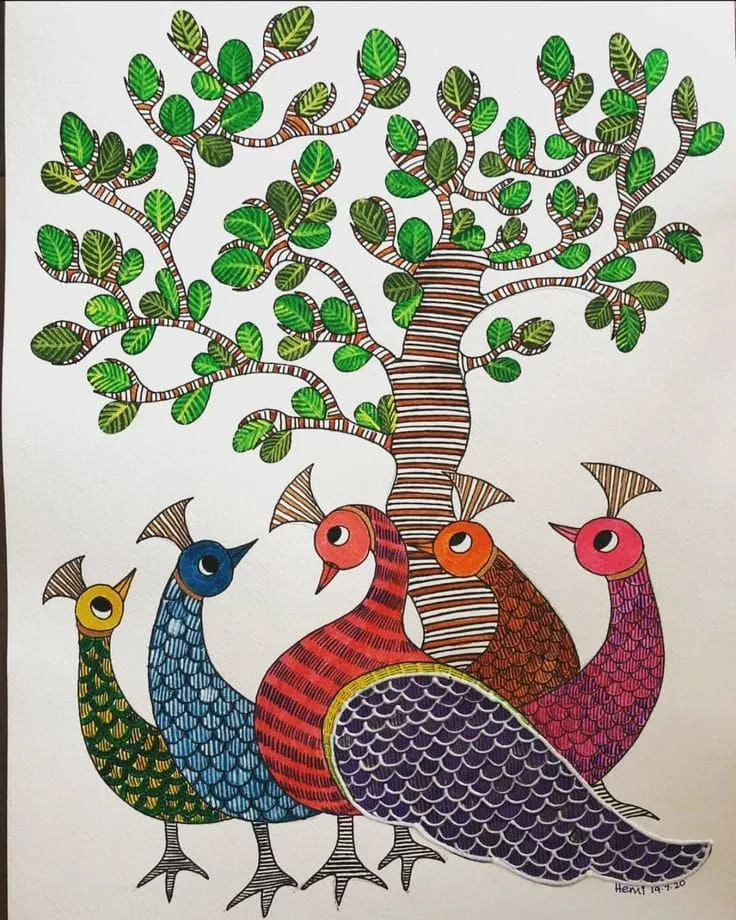
Gond Painting (image source: Pinterest)
Baiga painters treat the bird their own way. In Roopa Bai's Nachta Hua Mor, the dancing peacock's tail is filled with the dense patterning the Baiga also use for tattoos.
In the jungle, the animals decide to elect a new king. The peacock, known for its stunning beauty, and the owl, respected for its wisdom and nocturnal abilities, are the main contenders. Confident in its appearance, the peacock believes it will easily win the admiration of the animals. The animals gather for the contest. The peacock proudly displays its colorful feathers and dances, mesmerizing the animals with its beauty. However, when night falls, the peacock's beauty becomes invisible in the darkness.
Meanwhile, the owl, with its ability to see in the dark and its wisdom, proves its practical value by guiding and protecting the animals during the night. The animals, realizing that true leadership requires more than just external beauty, choose the owl as their king. The peacock learns a valuable lesson: that inner qualities like wisdom, usefulness, and the ability to lead effectively are far more important than superficial appearances.
the peacock and its feather holds a unique place in Indian culture, spirituality, and art. Its presence in various art forms, from traditional Warli and Gond paintings to modern glass work and textiles. The morpankh symbolizes beauty, prosperity, and spirituality, deeply embedded in mythological tales and religious practices. By integrating morpankh into diverse artistic expressions, artists celebrate its multifaceted symbolism and enhance the cultural heritage of India.
How to draw a morpankh, step by step
- Draw a gentle S-curve for the shaft.
- Two-thirds of the way up, draw a teardrop, point down, for the eye. Fill it dark blue.
- Ring the eye with turquoise, then a thin band of gold or copper, then green.
- From the shaft, pull fine lines outward and slightly upward on both sides for the barbs. Keep them loose near the tip.
- For a Warli version, use white on brown and reduce the eye to a circle inside a circle.