

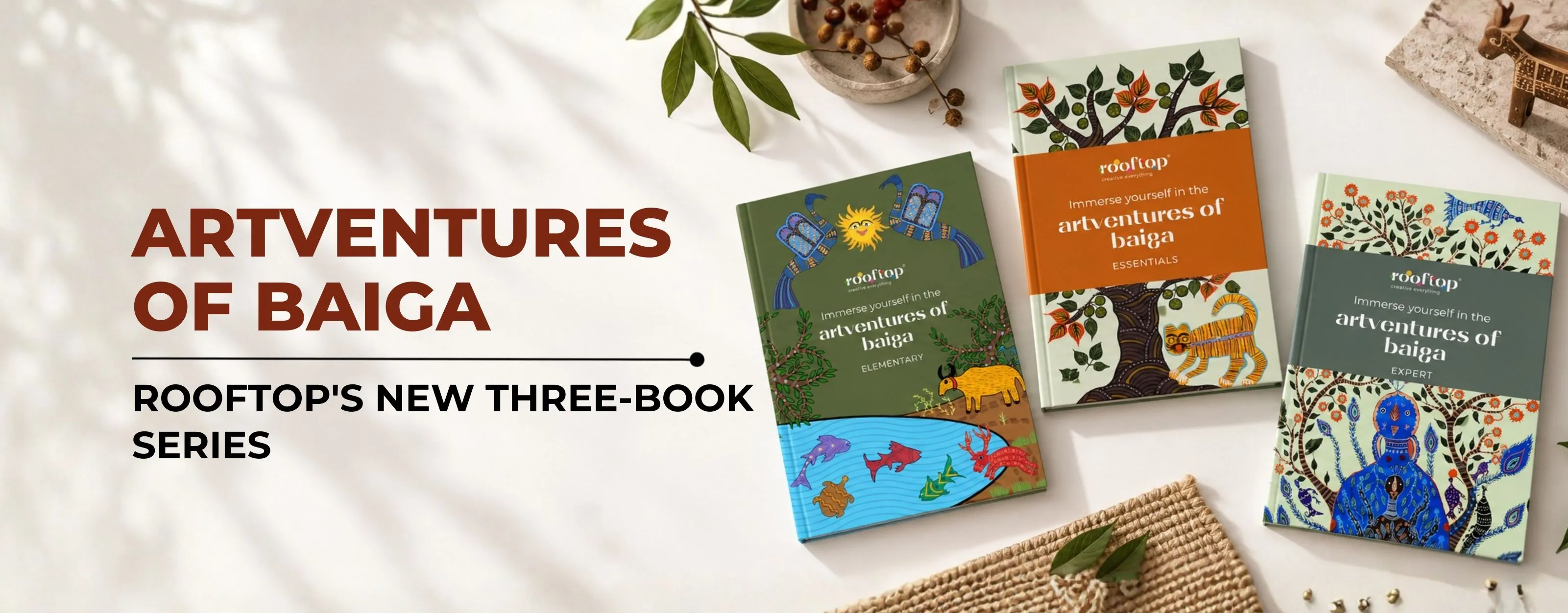

Artventures of Baiga is the newest addition to Rooftop's Artventures series of art books, and it runs to three levels: Elementary, Essentials and Expert. Facts about the artists below were checked against Press Information Bureau records, national news reporting and Rooftop's own artist pages. The conflicts that turned up are flagged at the top of this document rather than smoothed away.

The three levels of Artventures of Baiga, Elementary, Essentials and Expert, shown together. Shop now
Jodhaiya Bai Baiga was sixty-nine when she first put Baiga painting on paper. Before that the art form lived in two places, the mud walls of houses in Umaria district and the skin of Baiga women, and neither surface was built to survive. Wall paintings go with the monsoon. Tattoos go with the person. Almost nothing from before 2008 exists to look at.
That is the gap these books are trying to close. Artventures of Baiga is out now in three levels, Elementary for children, Essentials for older learners and adults, and Expert for people who already paint. Every motif in all three traces back to five women of Lorha village in Umaria district, Madhya Pradesh.

Sakun Bai Baiga, Ramrati Bai Baiga, Jodhaiya Bai Baiga, Rupa Baiga and Hema Baiga, the five painters whose reference work the three books are built on.
What Baiga painting is, before you draw any of it
The word Baiga means sorcerer, or medicine man, which is what the community was to the villages around it. The Government of India classifies the Baiga as a Particularly Vulnerable Tribal Group. They call themselves Mati-Putra, children of the soil, and they have historically refused the metal plough on the grounds that ploughing opens a wound in the earth.
Where the Baiga live
Six districts of Madhya Pradesh carry the community and the painting. The books name all six.
⬛ Mandla Narmada valley, one of the older Baiga belts
⬛ Dindori Home district of Baiga dance and song
⬛ Shahdol Forest and coalfield country to the north east
⬛ Umaria Lorha village sits here, and all five artists work from it
⬛ Balaghat Southern edge, bordering Maharashtra
⬛ Amarkantak Where the Narmada rises, and a pilgrimage town
The painting runs on five colours. Red, blue, brown, yellow and black, taken from turmeric, indigo, vermilion, white clay and rice paste, applied with a brush cut from a bamboo stick. Figures are drawn for what they are doing rather than what they look like, so a wobbly deer is still a deer. And the background gets filled, all of it. Baiga painters leave no negative space, which turns out to be the hardest habit for a trained artist to pick up.
For the longer version of the history, the colours and the Godna designs before you commit to a book, the Baiga entry in Rooftop's art wiki covers it.
The five artists the books are built on
Baiga painting reached paper because of one outsider. Ashish Swami, a fine artist trained at Kala Bhavan in Shantiniketan, ran a studio called Jangan Tasweerkhana and came across the wall work in Lorha. He taught more than thirty women there to paint on paper. He died in the second wave of COVID in 2021, two years before his first student was given the Padma Shri, so he never saw it.
Jodhaiya Bai Baiga started in 2008. Her work went to Bhopal, Delhi, Milan and Paris, and she made her international debut at eighty. She received the Nari Shakti Puraskar for 2020, presented in March 2022, and the Padma Shri in 2023. She was still living in a mud and asbestos house when the Padma Shri was announced. She died at Lorha on 15 December 2024, at eighty-six.
The other four are Sakun Bai Baiga, Ramrati Bai Baiga, Rupa Baiga and Hema Baiga, three generations of one family, all painting today. Sakun Bai and Ramrati have each been at it about nine years. They teach as well, and front the Baiga course on Rooftop alongside Rupa.
Elementary, for ages six to twelve
Elementary opens with a story instead of an introduction. Prakash walks home from school and finds his Amma painting animals onto the wall of their hut, and her answers to him carry the history: who the Baiga are, why they call themselves children of the soil, what the Godna marks on her hands mean. Then the drawing. Seven pattern pages of dots, wavy lines with sparks, zigzags that Amma compares to lightning, and flower and dot borders. Six motifs broken into four numbered steps each with a blank facing page to practise on, a tiger, a Nandi, a caterpillar, two peacocks and a crab. The last third is activity work: dot to dot owls and turtles, Ganesha and Mushak Raj waiting to be filled with pattern, a bare tree that needs its animals drawn in, and a deer herd where every animal takes a different design.
All three levels are on the shop now, and Artventures of Baiga: Elementary is the one to start a child on. Colour pencils or poster paints and a pencil, nothing else.
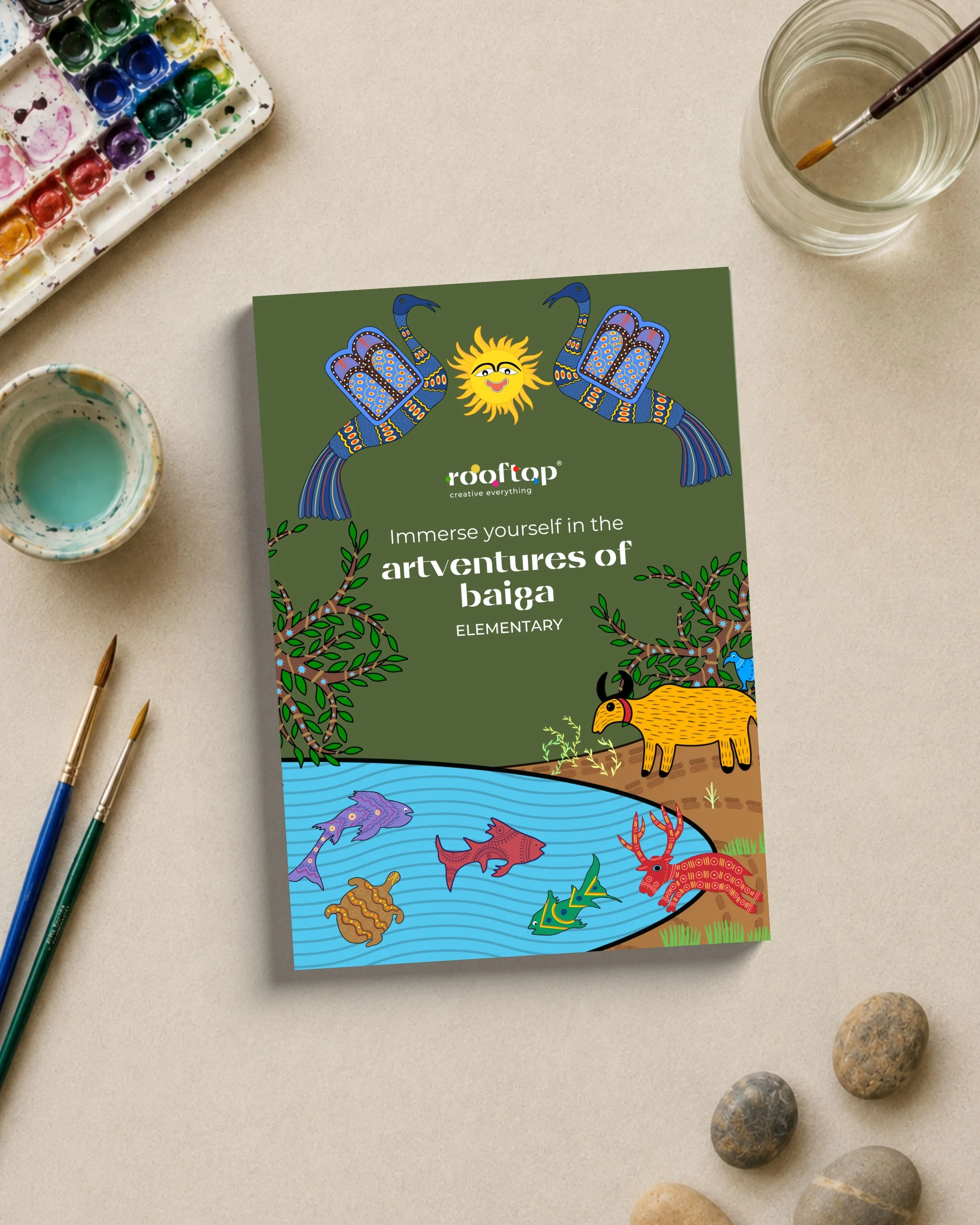
Artventures of Baiga: Elementary. Ages six and up, and needs nothing but colour pencils or poster paints and a pencil. Shop on Rooftop
Essentials, for older learners and adults
Roughly a third of Essentials is reading before you draw anything, and that is deliberate. It covers the etymology, the six districts, the five colours and where each pigment comes from. Three deities get their own pages: Bada Dev, guardian of the forest, honoured before planting and again before harvest; Baghsur, the tiger spirit, prayed to by people who work inside forests where tigers actually live; and Kali Mata, whom the Baiga approach as a protective mother rather than only as a destroyer.
The Godna section is the most specific writing in the book. Seeta Rasoi on the forehead marks adolescence. Kajeri and Palani, both built from dots, follow marriage. The ink is made from black sesame, Bija wood or the fluid of the Malwan tree, the work is done by women called Godharins using thorns and needles, and turmeric and herbal oil go on afterwards to heal the skin. Men are kept away, because the Baiga hold that their presence would affect the hunting.
The practice takes the rest. Six reference paintings reproduced full page and credited by title and artist, including Mahua Devi and the Tree by Jodhaiya Bai Baiga and Bholenath Ka Darbaar by Sakun Bai Baiga. Six pattern exercises, seven motif pages, and thirteen creative exercises with a blank facing page each. That last section of Artventures of Baiga: Essentials is where it stops holding your hand:
- Repaint two lizards in your own colours
- Add pattern to a bull's horns, a Baiga lamp and a Sheshnaag
- Draw the villagers around a Mahua tree, and bring a barren Palash tree into spring
- Fill an entire background behind a peacock, because there is no negative space to fall back on
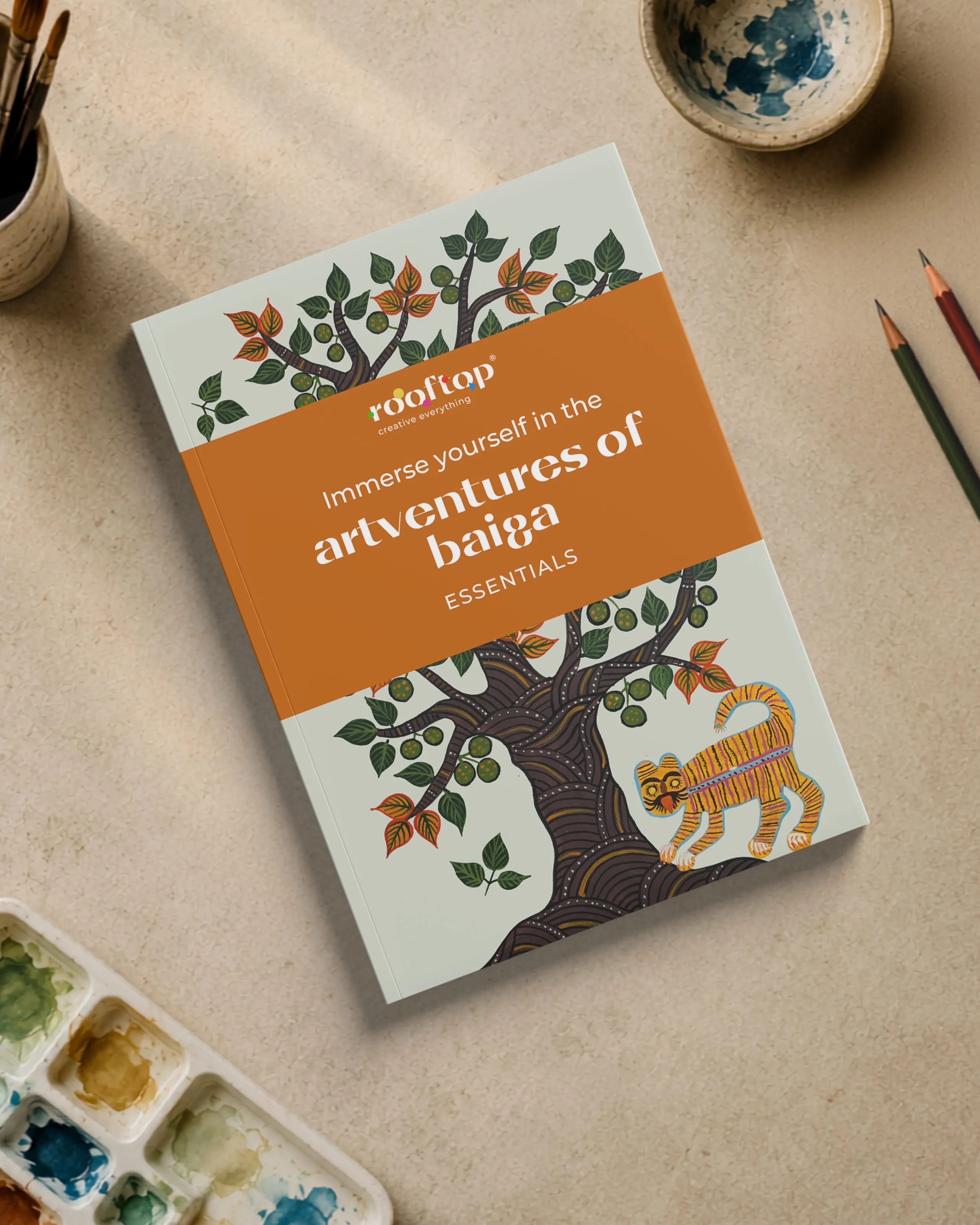
Artventures of Baiga: Essentials. Roughly a third of the book is Godna and deity material read before any drawing starts. Shop on Rooftop
Expert, and the only dictionary in the series
Artventures of Baiga: Expert is the one I would argue is most useful, and not because it is the hardest. It has the dictionary. Four pages catalogue roughly forty forms drawn from the artists' own work: Chora Devi, Ganesh Ji, Mahua Devi and Bada Dev; temple, sun, incense sticks and flag; the Saja, Mahua, Kullu and Palash trees with four leaf types; fifteen animals, birds and reptiles including the porcupine, tortoise and scorpion; four human figure constructions; and five weapons. That list has not been published anywhere before. It means you can build a composition without inventing shapes, which is the failure mode of most folk art practice books.
The history goes further than the other levels too. Baiga legend credits the art form to the goddess Mavai, who came down and taught the community to make designs from clay, leaves and plant dyes. Separate sections cover the Mahua tree, whose flowers are gathered in season and made into the drink shared at every important festival, the Ojhas and Badnins who tattoo Baiga women with soot mixed with water and pass the designs down orally, the lugra garment, and the belief that a woman who dies untattooed is marked in the afterlife with a ploughing instrument. A closing section takes on urbanisation. Fewer young Baiga take the tattoos, artists have moved to canvas and acrylics, and the book treats both as adaptation rather than loss.
Practice is pitched to match. Eight full page reference paintings, four advanced pattern exercises, nine advanced motif pages, and then staged compositions rather than single subjects. Recreate Whispering Woods and Joyous Jungles, complete a Kali sketch with tattoo designs, finish the missing half of a paired peacock, and stage an episode from the Ramayana in Baiga style. The open briefs ask for a Baiga cosmos, invented forest guardians, a folktale and a treehouse, and the book closes with a word search and a twenty clue riddle hunt, answer keys included.
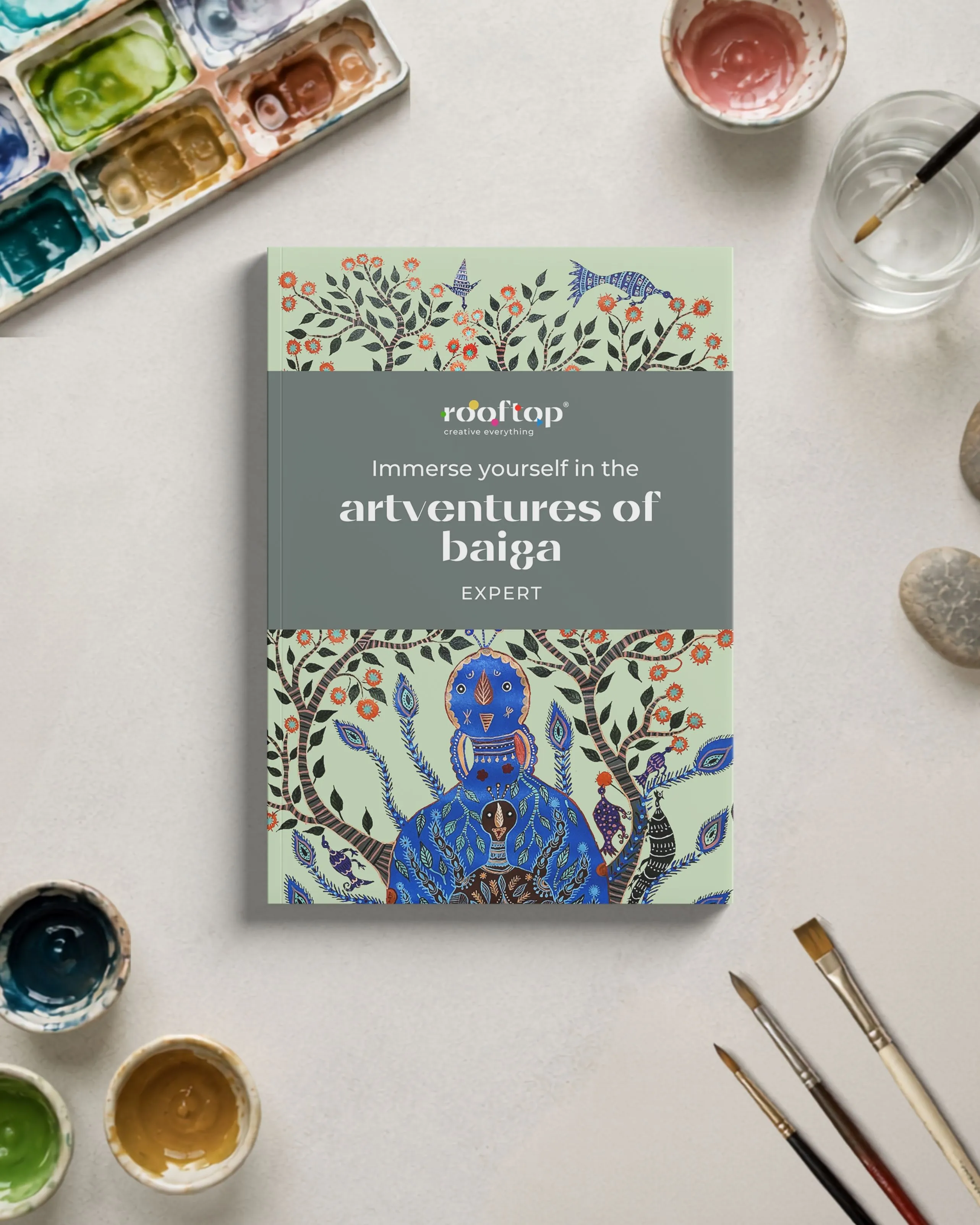
Artventures of Baiga: Expert. The only book in the series with the forty-form dictionary. Shop on Rooftop
Which level to actually buy
If there is a child in the house, buy Elementary and ignore the rest of this paragraph. If there is not, start with Essentials even if you already paint well in another tradition, because the Godna and deity material is what makes the motifs mean anything, and Expert assumes you have it. Doing Elementary and Essentials both is repetitive rather than useful. They tell the same history, one through Prakash and his Amma and one straight.
One caveat worth stating plainly. These books teach you the vocabulary of a living tradition, not a licence to sell work in it. Baiga painting belongs to the women of Lorha and the villages around it, and the artists were paid for the reference work these books adapt.
The books also work better alongside the artists themselves. The Baiga course taught by Ramrati, Sakun Bai and Rupa runs through the same motifs on video, in their hands and their words, and ends with a certificate.
Jodhaiya Bai Baiga sold compost, firewood and forest nuts until she was nearly seventy. She had sixteen years as a painter and spent them making the case that Baiga work belonged in Milan and Paris and Delhi. The four artists still in Lorha are the ones who keep that going now. A book of practice pages is a modest way to help, but a child in Pune drawing a four step tiger from Sakun Bai's reference is one more person who knows the name of the form.