

Your Cart

Your cart is empty
Sandip Dhurve cover banner
Sandip Dhurve

Sandip Dhurve

Masterful focus on birds as symbols of memory and continuity

Gond
Experience

10 years

Location

Bhopal

Courses

0

Artworks

6

About the Artist

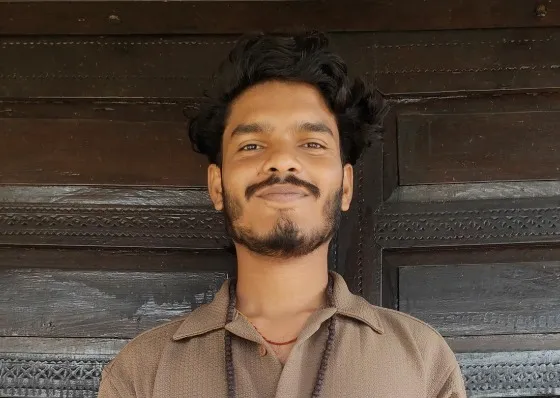
Sandeep Dhurve was born on July 9, 2001, in Patangarh, a village in the Dindori district of Madhya Pradesh that is, by any account, the heartland of contemporary Gond art. It is the same village from which Jangarh Singh Shyam emerged in the early 1980s to transform the visual possibilities of an ancient tribal tradition, becoming the artist credited with the creation of the Jangarh Kalam, the distinctly modern form of Gond painting that now commands the attention of galleries and collectors worldwide. To be born in Patangarh into a family of Gond artists is to be born inside a living lineage, where the knowledge of how to make, what to make, and why it matters has been passed from hand to hand across generations without interruption.

Sandeep's father, Suresh Kumar Dhurve, is one of the most respected figures in that lineage. Mentored directly by Jangarh Singh Shyam, Suresh Kumar is known for paintings that centre on birds as memory, rhythm and identity, works that began in vivid colour and evolved, over time, into a predominantly monochromatic practice where birds emerge in quiet elegance, their wings etched in rhythmic detailing, their forms simultaneously fragile and strong. His first solo exhibition was held at Bharat Bhawan in Bhopal in 2007, and his work has since travelled to international platforms including the National Gallery of Canada. Suresh Dhurve is among the Bhopal artists who form the core of Jangarh's creative community, a group that continues to advocate for the proper recognition of Jangarh Singh Shyam's foundational role in the tradition that bears his name.

Sandeep grew up watching his father work. Raised and educated in Bhopal, he absorbed the visual grammar of Gond art not as formal study but as daily exposure, the kind of learning that enters the hand before it enters the mind. After completing his college education, he committed to art full-time and has spent the past two to three years building a body of work that is in clear and considered conversation with his inheritance while developing its own distinct character.

Where his father's work is anchored in birds and the emotional world of the natural world's most visible creatures, Sandeep has expanded his subjects to include the less-seen: unusual insects, the quiet complexity of flora and fauna, sealife, and the textures of the forest floor. His motifs are unnamed, drawn not from iconographic convention but from direct observation of natural surfaces: the wrinkle of animal skin, the arrangement of feathers, the pattern that dried mud makes when it cracks in the heat. These are the textures of close looking, of an eye that finds form in what most others overlook. Applied to paper and canvas in monochromatic ink and acrylic, they produce images of considerable density and stillness, works that ask the viewer to slow down and attend.

Sandeep works across paper, canvas and murals, and takes on commissioned projects, maintaining both a studio practice and a connection to the public-facing world of applied Gond art. He has mentored fellow artists, including Gond artist Lata Ji, and continues to refine his practice through workshops. His aspiration is the same one that runs through every generation of this tradition: to make work that people will want to live with, that carries the cultural memory of the Gond people into the homes of those who choose to hold it.

Mediums

Acrylics on canvas/paper

Pigments

colour to monochrome evolution

Artist Creations

Explore original artworks and creations by Sandip Dhurve

Fishes I
Certified

Tribal Art

Fishes I

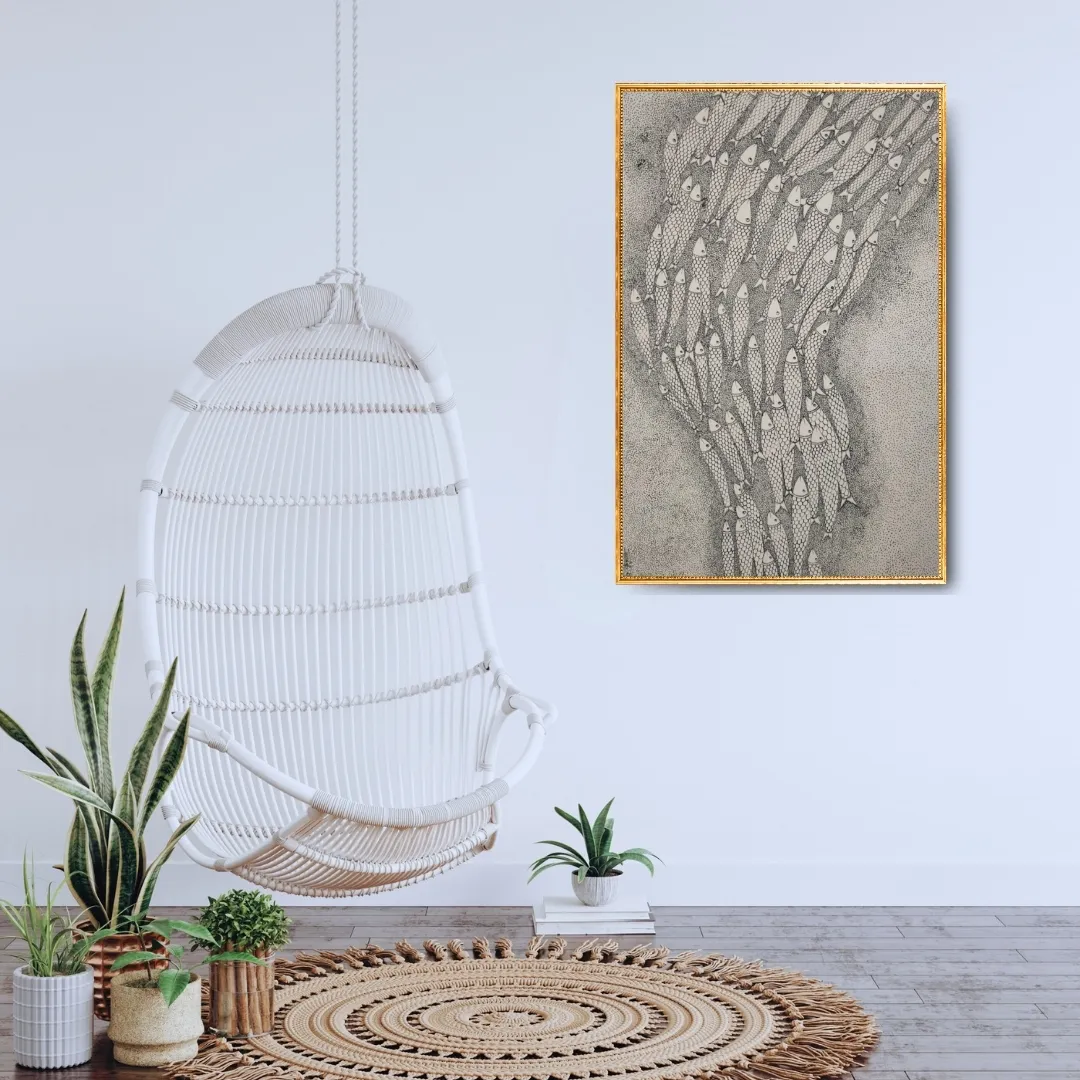
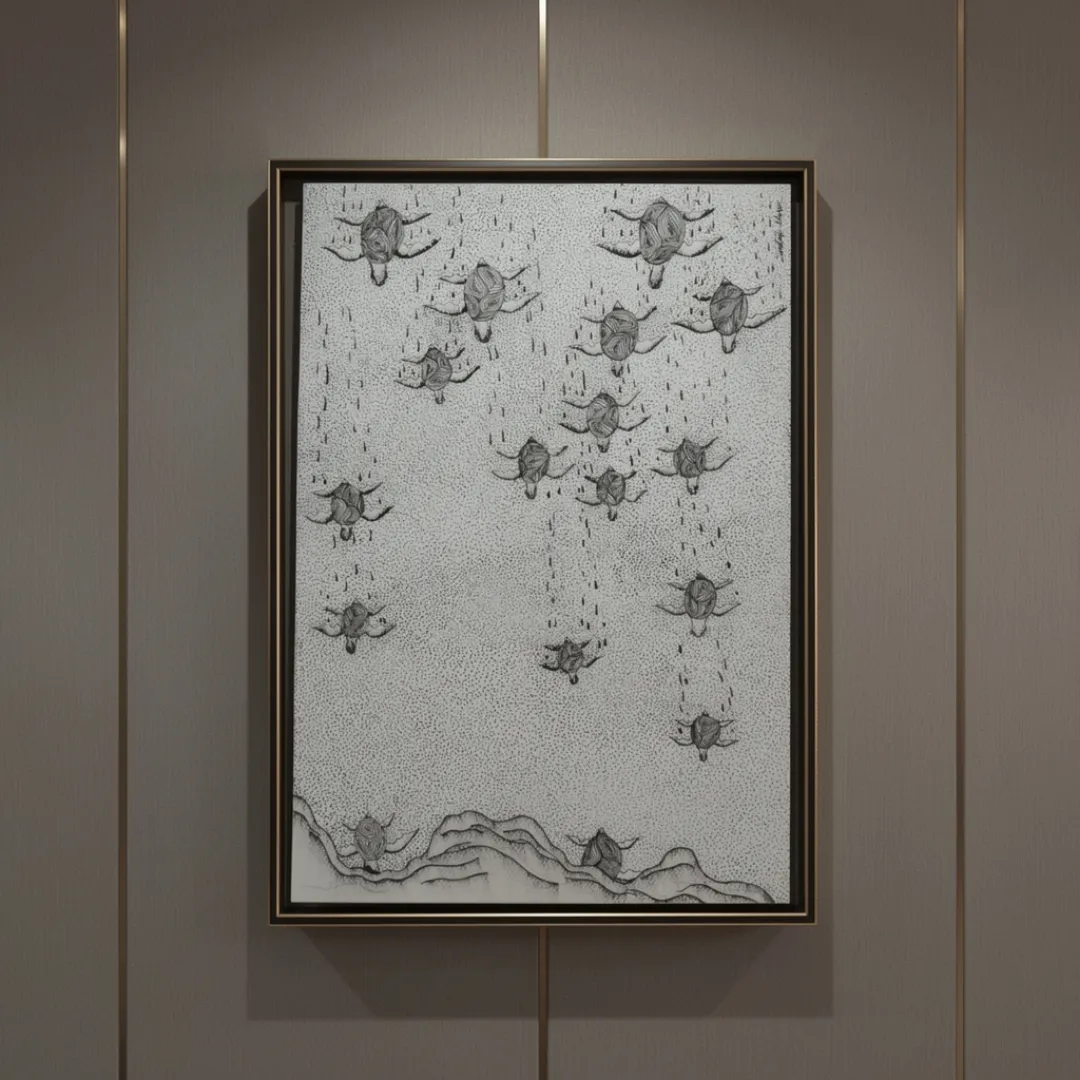
Across a pale, open field, fish fall like rain. Dozens of them descend through the composition, each body filled with the flowing concentric lines that are the signature language of Gond mark-making, spiralling inward as though the creature carries its own small cosmos within. Thin vertical strokes scatter between them, suggesting water, air or the simple passage of things through space. Nothing anchors the scene to a fixed horizon. The fish are neither rising nor falling with urgency; they move through the picture plane with the unhurried certainty of creatures that belong equally to depth and to sky. At the base of the painting, undulating wave forms settle into the lower edge, offering the gentlest suggestion of water waiting below. Sandeep Dhurve works in the Gond tradition of Madhya Pradesh, a visual language in which every living form is understood as a meeting point of pattern and spirit. The concentric fill that gives each fish its density is not simply ornament; it is the tradition's way of showing that life moves in continuous, interconnected currents. Working in acrylic on paper, Dhurve brings a graphic clarity to the composition, the white ground acting as both sky and sea, giving the repeated forms room to breathe without ever losing their collective rhythm. The dotwork atmosphere surrounding each fish charges the negative space, making the emptiness feel alive and inhabited. Why This Artwork Stands Out The all-over, gravity-free composition dissolves the boundary between water and air, creating a meditative visual field that invites extended looking. Each fish is individually rendered with Gond concentric patterning, giving the repeated motif an intimacy that resists mere decoration. The monochromatic palette of black on pale paper gives the work a quiet intensity, allowing form and mark to carry the full weight of the composition. Sandeep Dhurve's command of the Gond visual language transforms a single repeated subject into a sustained meditation on movement, pattern and natural abundance.
$ 459
Trees III
Certified

Tribal Art

Trees III

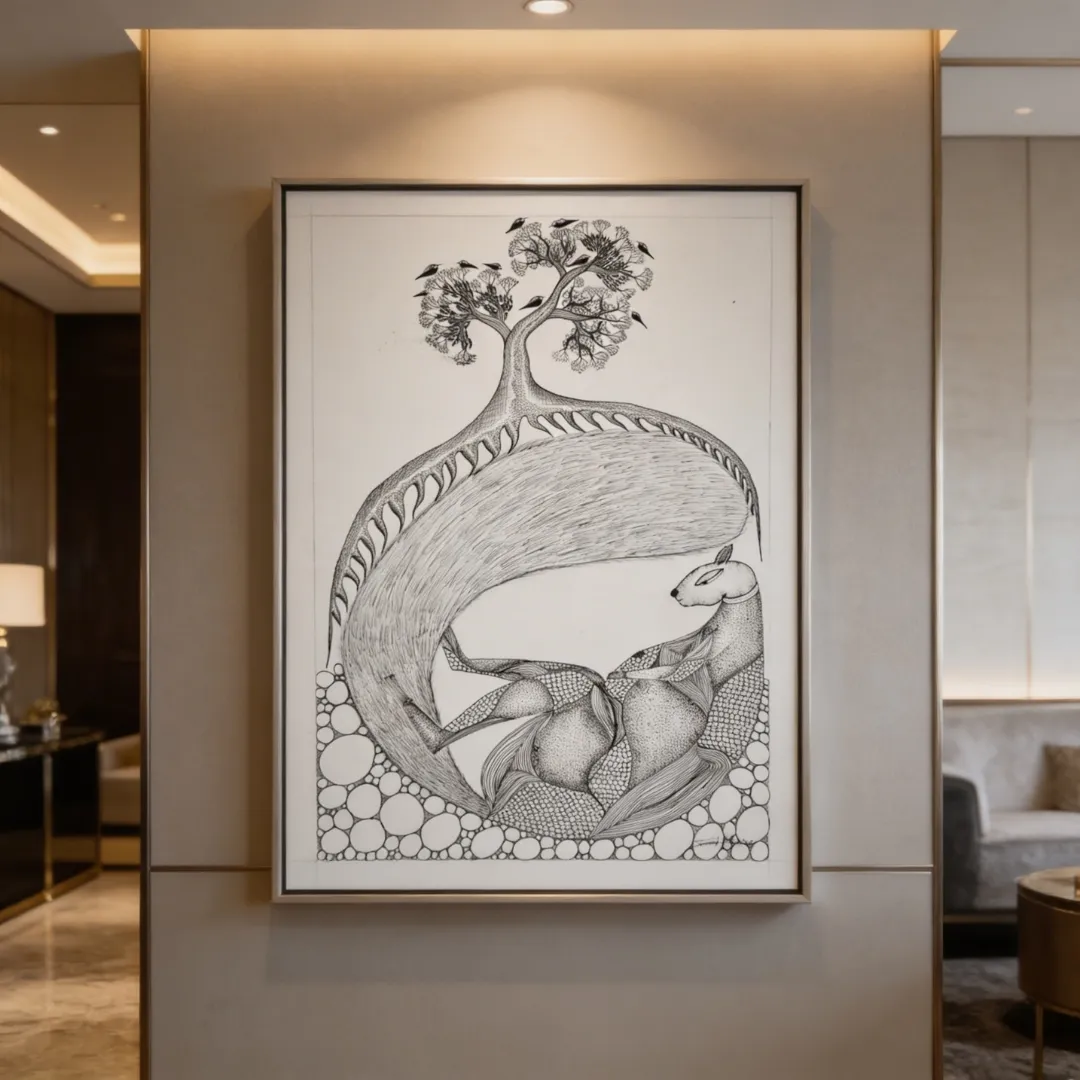
A tree rises from the upper half of the composition with the unhurried authority of something that has always been there. Its canopy spreads wide and full, birds perched quietly along its branches as though they have chosen this particular tree above all others. Below, the trunk does not simply descend into roots. It curves, sweeps and billows outward in a great arc, its body filling with dense parallel hatching that gives it the weight and warmth of living wood. The inner edge of this arc is lined with a row of pointed forms, like teeth or leaves or the repeated breath of something ancient, marking the boundary between the tree's interior world and the open space it holds within its curve. Sheltered inside that curve, a deer rests with its legs folded beneath it, its small alert face turned gently outward. The ground beneath is rendered in close circular patterning, stones or seeds or the simple fact of earth, while larger hollow circles border the lower edge of the painting like a quiet, rhythmic refrain. Sandeep Dhurve works in the Gond tradition of Madhya Pradesh, where the relationship between tree and creature, root and sky, is not metaphor but worldview. Every mark in this composition, the hatched trunk, the textured earth, the dotwork body of the deer, carries the visual logic of a tradition that understands all living things as continuous with one another. In acrylic on paper, Dhurve renders this understanding with a precision that feels both ancient and entirely his own. Why This Artwork Stands Out The sweeping arc of the tree trunk creates a natural shelter around the resting deer, making protection and interdependence the quiet subject of the entire composition. The variety of mark-making across a single monochromatic palette, hatching, dotwork, concentric circles, scale patterning, demonstrates the full range of the Gond visual vocabulary within one unified work. The birds in the canopy and the deer at the root establish a vertical axis of life, connecting sky, tree and earth in a single unbroken gesture. Sandeep Dhurve's command of line and texture gives the composition a density that rewards sustained attention, with new detail emerging the longer one looks.

$ 459
Fishes II
Certified

Tribal Art

Fishes II

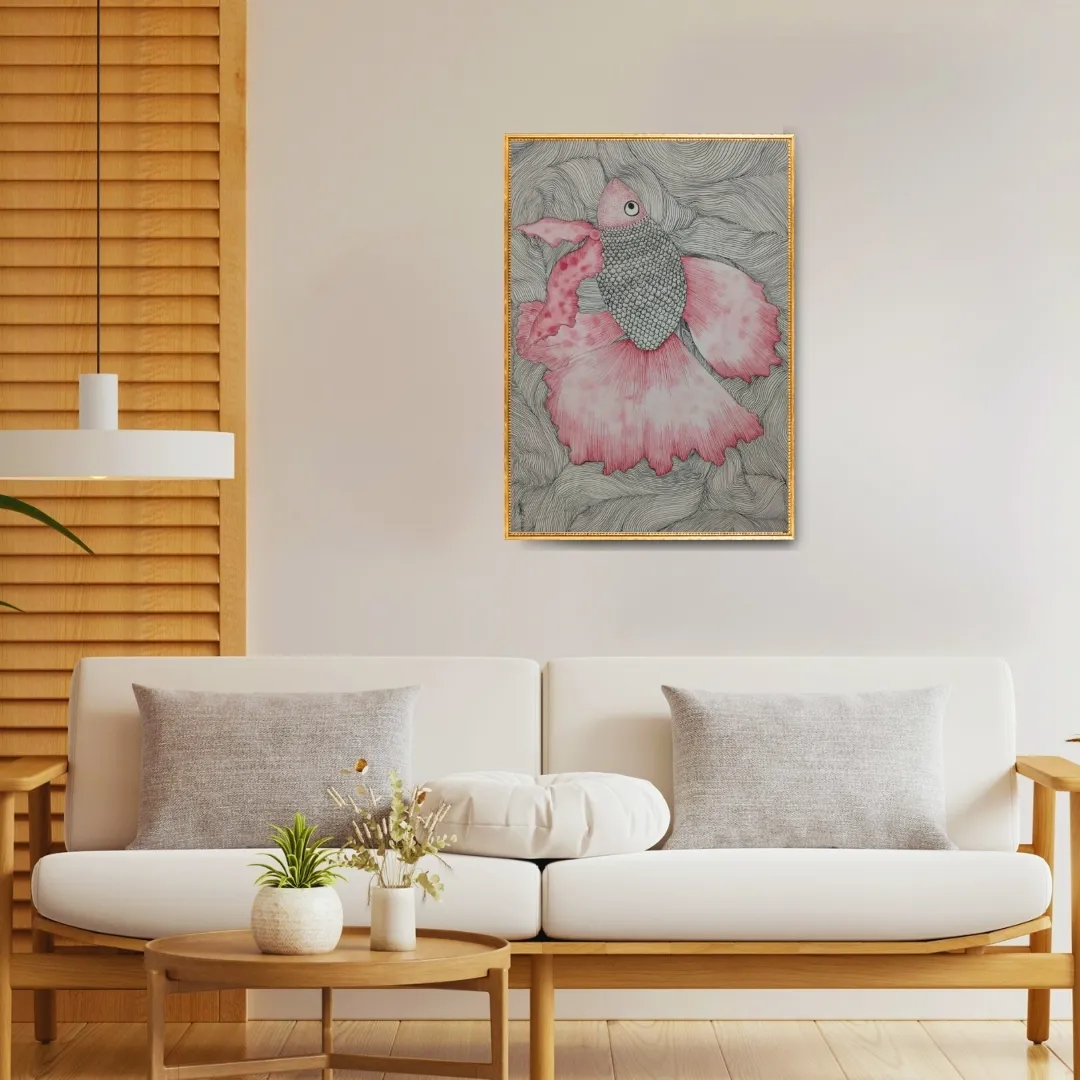
A single fish fills the frame with the quiet confidence of something that knows it belongs exactly where it is. Its body is rendered in dense, carefully built scale patterning, each small form pressing against the next with the patient accumulation of a craftsman who understands that structure is its own kind of beauty. From this grey, textured core, great fins billow outward in deep rose and blush, their edges ruffled and full, radiating fine parallel lines from the body's centre to the outermost tip like light spreading through water. The fins do not simply extend from the fish; they expand, filling the composition with a soft, ceremonial presence that is closer to a gown than a gesture. The ground against which all of this unfolds is a sea of flowing grey linework, wave upon wave of close parallel curves that move in unison without ever becoming monotonous. The fish sits within this field not as a subject against a backdrop but as one form of movement held briefly still within another. Sandeep Dhurve works in the Gond tradition of Madhya Pradesh, a visual language built on the understanding that every living creature carries its own inner world of pattern and energy. The contrast here between the cool monochrome of the undulating ground and the warm rose of the fins is not decorative but felt, a single creature luminous against the continuous flow of everything surrounding it. Working in acrylic on paper, Dhurve renders the natural world as a place where beauty and structure are always one and the same. Why This Artwork Stands Out The juxtaposition of densely scaled body and expansive flowing fins creates a visual tension between containment and release that gives the composition its emotional charge. The rose and blush palette of the fins against the monochromatic wave ground makes this one of Dhurve's most striking works in terms of colour contrast and spatial presence. The undulating linework of the background is itself a complete mark-making achievement, transforming negative space into active, living form. Sandeep Dhurve's command of scale, proportion and Gond visual grammar elevates a single subject into a meditation on grace, pattern and the natural world.

$ 459
Fishes III
Certified

Tribal Art

Fishes III

They move as one. Dozens of fish sweep across the composition in tight, overlapping streams, their bodies aligned with the kind of collective purpose that makes a school of fish look less like many creatures and more like a single living current finding its shape. Each fish is rendered with the same patient attention: scales built from small, interlocking circles pressed together in careful rows, a pointed head, a watchful eye, a tail that tapers into the next body behind it. No individual fish commands the composition. The power belongs entirely to the movement itself, to the great arcing flow that carries all of them in the same direction at the same unhurried velocity. The ground from which they emerge and into which they dissolve is a dense field of stippled dotwork, darker at the edges and softer at the centre, suggesting depth, water pressure and the particular quality of light that filters through deep water. There is no hard horizon, no fixed plane. The fish exist somewhere between surface and darkness, suspended in a space that feels genuinely aquatic. Sandeep Dhurve works in the Gond tradition of Madhya Pradesh, where repetition is never mere pattern but a way of understanding the world as continuous, interconnected and alive. Each scale on each fish is a mark made by hand, and the cumulative effect of hundreds of such marks held in formation is something closer to a natural phenomenon than a painting. Working in acrylic on paper, Dhurve transforms collective movement into a meditation on belonging, rhythm and the quiet intelligence of the natural world. Why This Artwork Stands Out The sweeping diagonal formation of the school creates a strong compositional current that carries the eye across the entire surface without rest, making the act of looking feel like participation in the movement itself. The repetition of individually scaled fish bodies, each rendered by hand, gives the collective mass an intimacy that purely abstract pattern-making cannot achieve. The stippled dotwork ground dissolves at its centre into open space, creating a sense of genuine depth and aquatic atmosphere within a monochromatic palette. Sandeep Dhurve's work demonstrates how the Gond tradition's visual grammar of pattern and repetition can describe the natural world with both precision and feeling.

$ 459
Porcupine
CertifiedOnly 1 left

Tribal Art

Porcupine

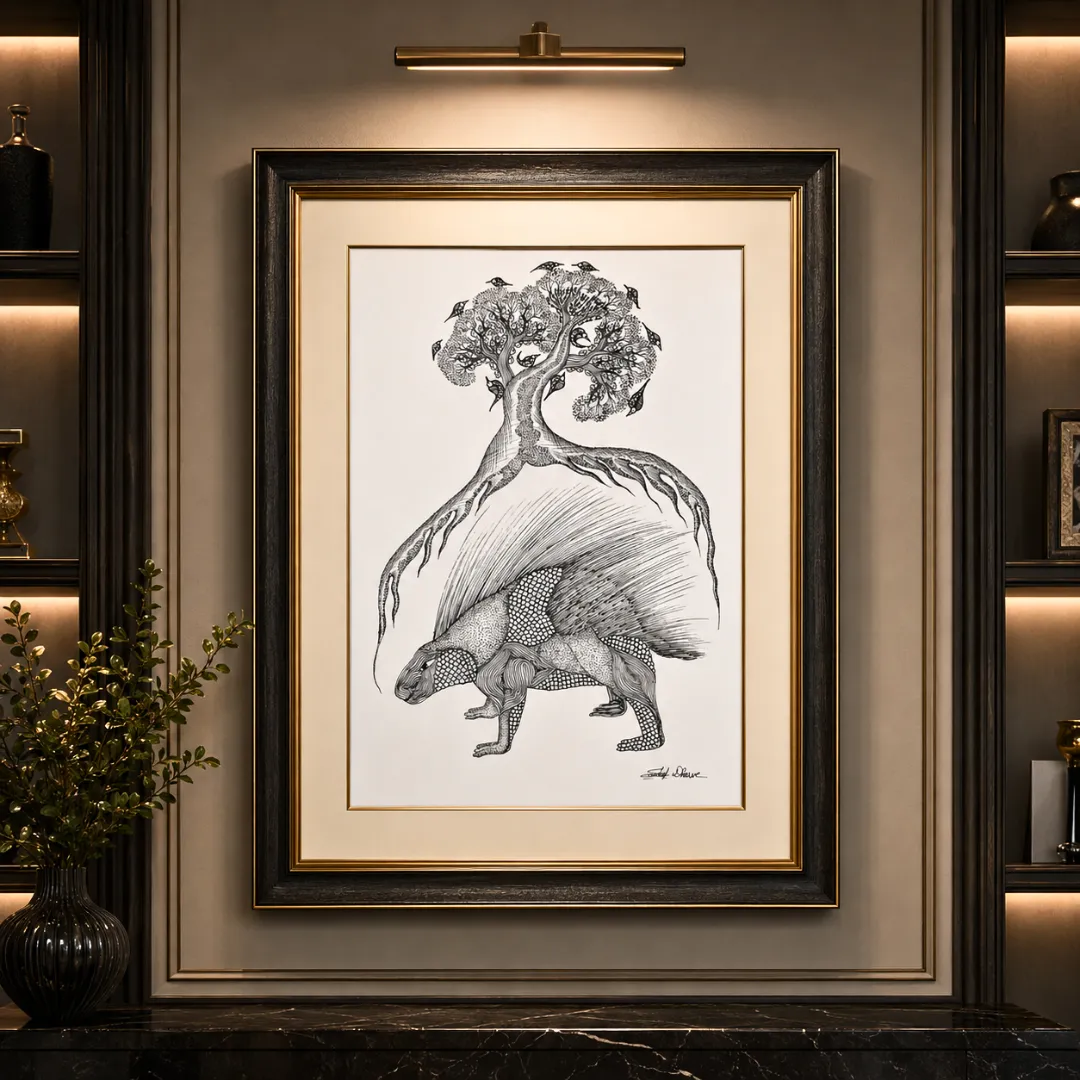
The tree and the animal are not two separate subjects. They have grown into one another so completely that it is no longer possible to say where the roots end and the creature begins. The porcupine moves through the lower half of the composition with a grounded, unhurried confidence, its body built from the same visual vocabulary as the tree above it: dotwork, scale patterning, close hatching, the layered marks of a hand that understands every living form as a system of interconnected textures. From its back, a great sweep of quills rises and fans outward, and it is here that the tree takes over, the quills becoming roots becoming trunk becoming the wide, bird-filled canopy that crowns the entire composition. The transition is seamless because in the Gond world view it is not a transition at all. It is simply how things are. Birds perch throughout the upper branches with the ease of creatures that have always lived here. The canopy is dense and full, rendered in the close dotwork and branching line that Sandip Dhurve uses to suggest not just foliage but the accumulated life that foliage supports. The white background throughout is not emptiness but space, held open so that the intricate mark-making of the figure can breathe. Dhurve works in the Gond tradition of Madhya Pradesh, a visual language built on the understanding that every creature carries a world within it, and that the relationship between animal, tree and bird is not metaphor but fact. This painting makes that fact visible, quietly and without argument, in the most direct and patient of marks. ### Why This Artwork Stands Out ### - The seamless visual integration of porcupine and tree collapses the boundary between animal and plant into a single, continuous form, expressing the Gond worldview of ecological interconnection with rare compositional intelligence. - The transition from quill to root to trunk to canopy is achieved entirely through mark-making, demonstrating Dhurve's mastery of the Gond visual vocabulary across multiple textures within a single work. - The birds in the canopy and the porcupine at the base establish a complete vertical ecology, from earth to sky, within the space of one quietly extraordinary image. - The monochromatic palette gives the intricate surface detail its full authority, with no colour to distract from the quality and precision of the mark itself.

$ 379
Birds
CertifiedOnly 1 left

Tribal Art

Birds

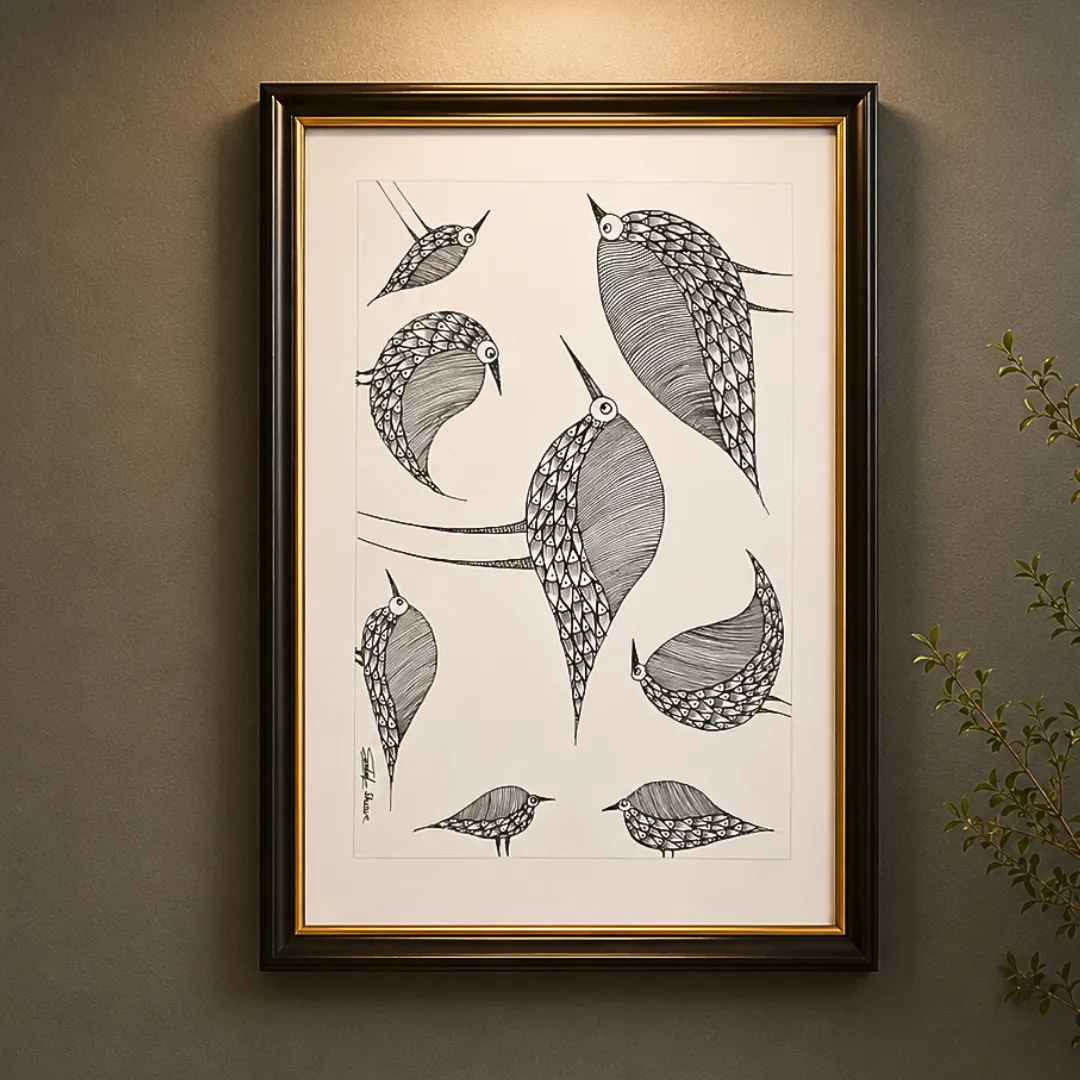
They go in every direction. Some point upward, some hang suspended at an angle, some face left, some right, one small pair rests at the bottom edge of the composition as though they have only just landed and have not yet decided where to go next. There is no flock logic here, no shared trajectory. Each bird occupies its own orientation within the white ground, as though thought itself has been given a body and scattered across the page in the moment before it coheres into something more orderly. This is precisely what Sandip Dhurve intended. The birds in this painting are a self-portrait of the mind at work, of the thoughts that arrive while the hand is moving, that go sideways and upside down and diagonal before they find their direction. Each bird is built with the same patient attention: scale patterning across the rounded body, fine parallel hatching in the wings, a large watchful eye, a sharp beak that points wherever the creature is going. No two are oriented alike. Together they create not chaos but the honest record of a mind thinking, which has its own rhythm and its own logic even when it does not announce them. Dhurve works in the Gond tradition of Madhya Pradesh, where the natural world is understood as continuous with the inner one, where a bird is never only a bird. Drawn on paper in monochrome, this work is one of the most intimate in his practice: a composition that is also a confession, a field of creatures that is also a field of thought. ### Why This Artwork Stands Out ### - The scattered, multi-directional arrangement of the birds translates the movement of thought into compositional form, making the painting's structure and its subject inseparable from one another. - Each bird is individually rendered with the full vocabulary of Gond mark-making, scale, hatch and dot, giving a composition of repeated forms, the intimacy and variation of a hand-written page. - The large, expressive eyes on each figure give the scattered birds a quality of alert interiority, so that the composition feels less like an observation of nature and more like an encounter with consciousness. - Dhurve's willingness to make his own thinking the subject of a Gond painting is a quietly radical gesture, demonstrating the tradition's capacity to hold personal and philosophical content within its visual language.

$ 379